


The development of new technologies in the construction industry isn’t just about increasing efficiency and productivity. It’s also about improving the safety of the on-site workers, including heavy equipment operators who sit behind the controls of complex machinery like bulldozers, excavators, backhoes, and pavers. Advancements are creating better, safer job sites for both current and future equipment operators.
The Timeline for Driverless Trucks
When we’re discussing autonomous trucks here, we’re talking about completely self-driving semis, big rigs, etc., that can operate without any human input. We’re separating them out from the hybrid approach of driver-assisted trucks that rely on a combination of self-driving technology and the insight of a human behind the wheel.
Driverless trucks are relatively new on the tech scene, with the first developments in this field happening in 2005, with the company Komatsu testing a fleet of five “ultra class” trucks (the largest haul trucks with a payload capacity of 300 short tons or greater).
Since 2005, we’ve seen the rise of multiple companies jumping into the race behind self-driving truck technology, with some of the top ones being Aurora, Gatik, Kodiak, Daimler Truck, and Einride. In December 2024, Kodiak was the first one to hand off two fully autonomous trucks to Atlas Energy Solutions, which the company has used to deliver loads in an off-road environment.
General consensus seems to be that we’ll see a wider rollout of Class 8 autonomous trucking on major highways starting next year. Lead company Aurora plans to grow from a handful of autonomous trucks to more than 200 by the end of 2026 and thousands by 2027.
Self-Driving Trucking Terminology
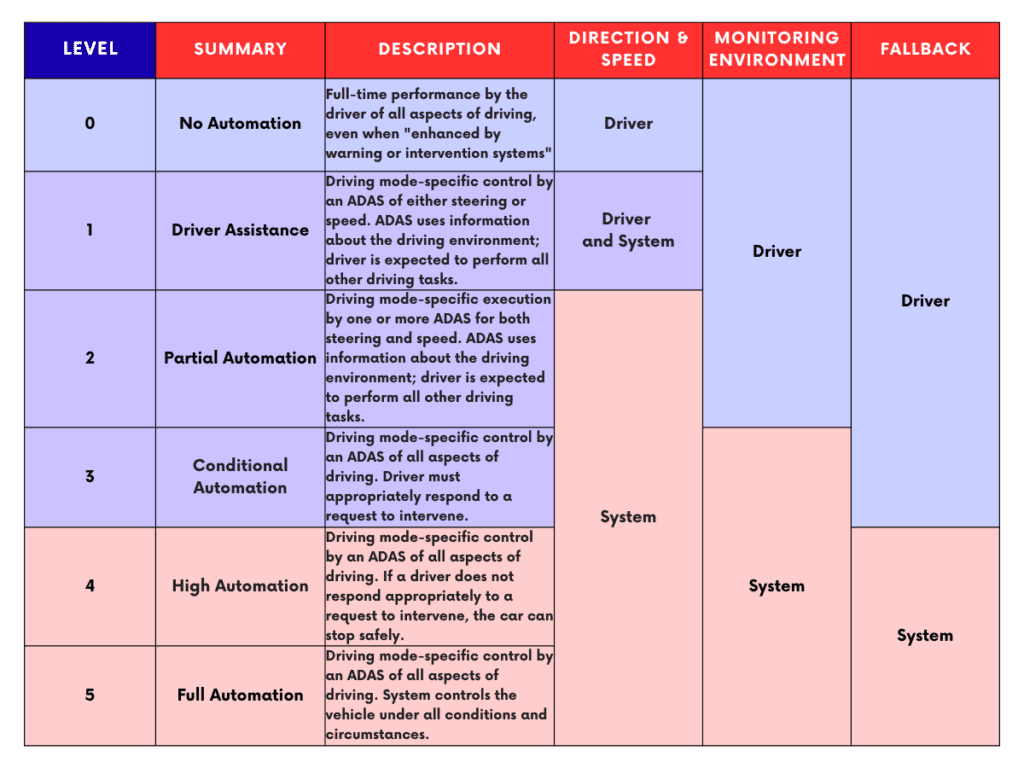
For autonomous big rigs, the self-driving technology is, in general, similar to the same engineering being used on consumer cars and vehicles. It falls within the six levels of driving automation defined by SAE International:
What’s Behind the Push for Autonomous Trucks
As usual in situations like this, there isn’t just one reason behind why companies are pushing forward with self-driving tech in the supply chain.
- Companies argue that this shift is needed because of a shortage of skilled truck drivers in the U.S. The American Trucking Associations estimated a shortfall of over 80,000 drivers in 2025 and a projected need of over 1.2 million new drivers over the next decade.
- They also say that self-driving trucks will cut costs and boost efficiency in freight trucking. Because no driver is required, an autonomous truck can run around the clock, cutting down delivery times. Companies believe it can also save on fuel costs.
- The other big claim is that driverless rigs bring safety benefits. Trucks are involved in thousands of crashes every year, and many crashes are due to human error. An autonomous truck, however, runs strictly on data without getting tired, which could reduce the number of accidents.
What Are the Downsides of Driverless Rigs
There is definitely not unanimous support behind the implementation of autonomous trucks. In fact, a January 2024 poll by AAA found that two-thirds of American drivers fear riding in an autonomous vehicle, and there are real concerns about fully removing drivers from behind the wheel.
- It isn’t for sure that we’d see real safety benefits from driverless rigs because there have been issues with the technology. Adverse weather conditions can inhibit sensors. Complexities in city driving have proved challenging. And advanced computer technology leaves trucks vulnerable to hacking.
- The biggest real-world tests of fully autonomous trucks are being conducted on long, straight highways in places like Texas where there is, more often than not, sunny, dry weather and minimal obstacles.
- If an autonomous truck does get involved in an accident, there is a lot of confusion over insurance and legal liability and who takes responsibility if someone is hurt or, God forbid, killed.
- Taking truckers out of the cabs may be financially appealing for companies looking to make more money, but they’re overlooking the impact it will have on professional drivers and avoiding taking into consideration the insight and input from those who are doing the real work.
The Future of Truck Driving
Tech companies may be excited about the possibility of driverless trucks, but this technology is still young and developing. What we’re seeing is not a massive shift to boot our truckers out of their cabs; instead, we’re seeing the advancement of driver-assisting devices that unite the skills and instincts of professional truck drivers with tech that can help make their jobs safer and easier.
At ASC Technical Institute, you can complete your Truck Driving CDL in just five weeks, from the first course to graduation. The curriculum includes comprehensive training, log record keeping, hazardous materials procedures, and more. If you want to learn more about how we’re preparing our students for the future of the trucking industry, contact us online and discover what ASC Technical Institute can do for you.